 DE
DE
Plausible is not the same as sourced
Persuasive language is not proof. Material claims need a passage you can follow, not just a fluent tone.
Decision perspectives
souveraen.ai prepares decisions instead of taking them. A proposal is checked from several viewpoints, material statements are tied to sources, and open points are made visible. At the end a person decides – not the machine.
 Permissions on every request
 A passage behind every statement
 A person decides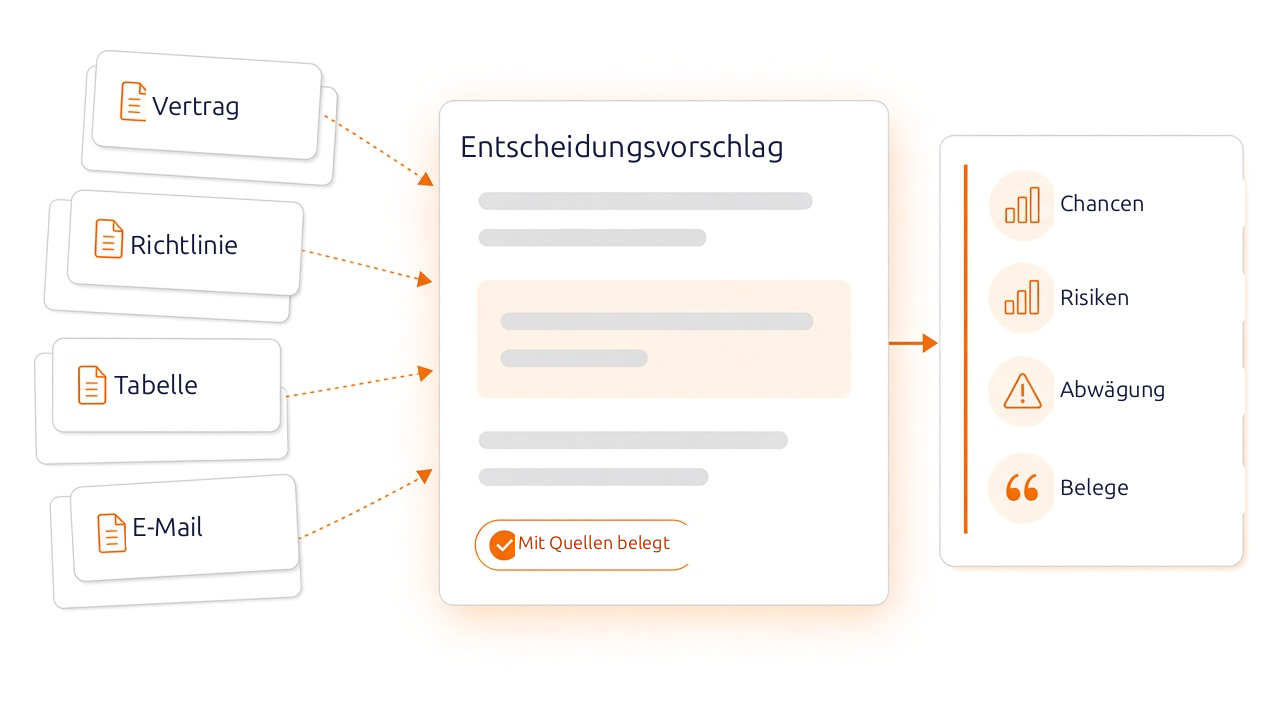

Why a second viewpoint
A single answer soon sounds convincing, especially when it reads fluently. For decisions that touch money, deadlines or liability, that is not enough.
Persuasive language is not proof. Material claims need a passage you can follow, not just a fluent tone.

One viewpoint can miss the counter-argument and the risk. What nobody checks, nobody will decide with their eyes open.
Contracts, policies, spreadsheets and mail can disagree. That conflict has to become visible before anyone builds on it.
souveraen.ai puts sources and viewpoints in front of you. A person decides – not the machine.
How a decision paper is created
Every proposal follows the same transparent route. What you get is a structured paper – sourced, challenged and ready for a person to decide.
The starting point is a question, a document, a request or a proposed decision.

The material is examined from several viewpoints and compared with company knowledge.
Every material statement receives sources and references. Contradictions and unresolved points are marked.

The results are structured into options, risks and a clear recommendation.
A responsible person reviews, supplements and makes the decision. There is no automatic approval.
An example from practice
A proposed delivery date is checked against the framework agreement, the procurement policy and the order confirmation. What holds, what conflicts, what stays open – each with the exact passage.
See the example →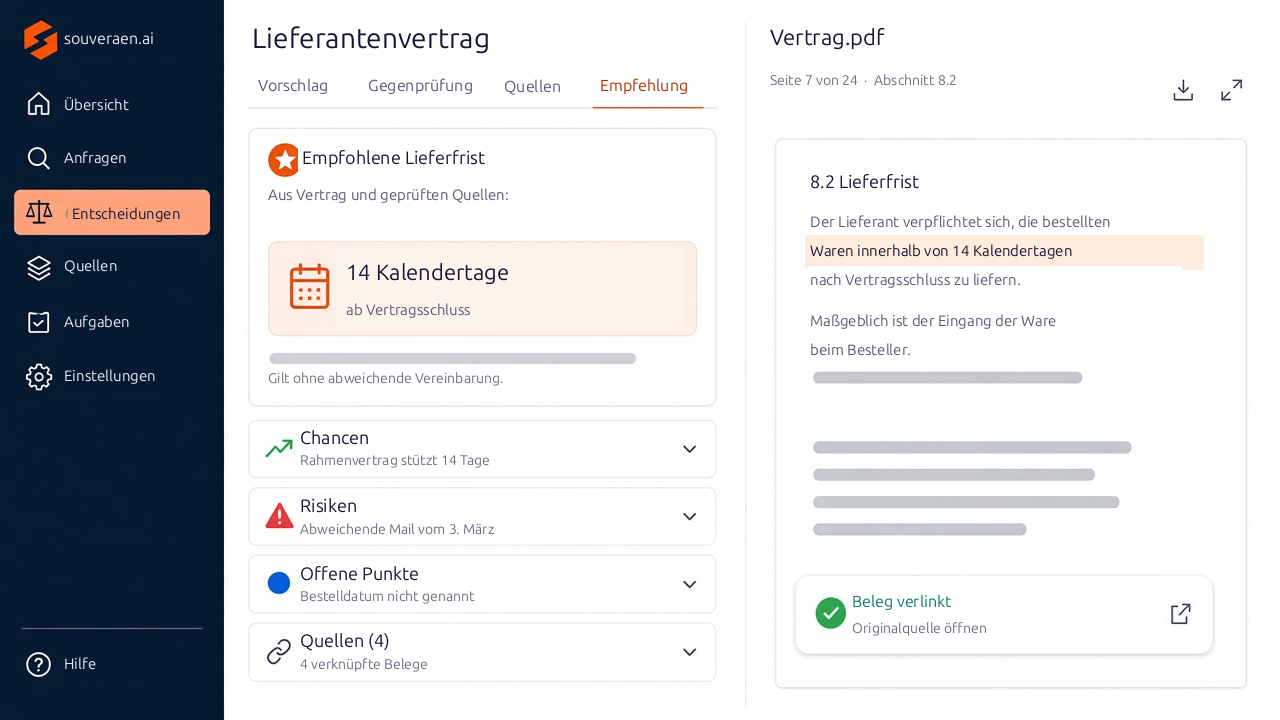
Checked from the other side
Every viewpoint works on the same body of company knowledge. What someone may not see feeds into no counter-check either.

Contracts, policies, liability, deadlines and regulatory implications are brought in.

Costs, dates, dependencies and contractual consequences are derived from the records already filed.
Conflicts, dependencies, uncertainties and possible courses of action stand side by side.

Every important claim is linked to its source and visible in context.
The decision stays with you
The system searches, compares, challenges and structures. It does not silently approve business decisions.
Interventions and commitments wait for a named person. The system confirms nothing in the background.
The recommendation, the sources and the open points are in the open before anyone decides.
Resistance, alternatives and contradictions stay visible – they are not smoothed away.
Only information the requesting person is authorised to see is considered.
Every relevant statement can be traced back to its original source.
Conflicting information is surfaced rather than silently reconciled.
Inputs, viewpoints, the recommendation and the final decision remain auditable.
Try souveraen.ai for three days with your own documents and real decision questions.
With your documents · With your permissions · With visible sources
Common questions
No. souveraen.ai prepares decisions: it argues against proposals, ties statements to sources and names the open points. A person decides; steps that intervene additionally require their explicit approval.
From the sources you have access to. Every viewpoint works on the same permission-checked body of knowledge; what someone may not see feeds into no counter-check either.
The contradiction is made visible rather than smoothed away. Conflicting statements go into a review queue, and the recommendation names the open point explicitly.
It covers sourced answers, contradiction detection and the research agent with its steps and sources laid open. On top of that sits the structured debate between several viewpoints, which ends in a decision paper with a recommendation, the open points and an approval.
No. The counter-check and the recommendation run on the appliance on your premises, on the same permission-checked sources as every other answer. There is no model interface at an outside provider.
Through the approval inbox: the recommendation, the approval and the receipt belong to one case. Months later it is still traceable who decided what, and on what basis.